Tuesday, April 19, 2011

UPDATE: Spectrum Pharmaceuticals (SPPI) - bullish ahead of major FDA catalyst

Spectrum Pharmaceuticals (SPPI) will hear from the drug regulator regarding the prospect of approval of the biotch's experimental drug, Fusilev (read more about SPPI and Fusilev).  

SPPI is up more than 6% in the last week alone, as investors' interests grew ahead of Spectrum's scheduled PDUFA date, Apr. 29, 2011.  


Meanwhile, corresponding to the rising share price, May $9 call options have seen even larger gains (up ~43% since last week: $.70 --> $1).  
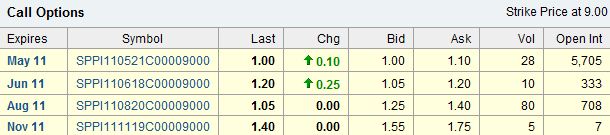

This is not the first time Spectrum has tried getting Fusilev approved for advance colorectal cancer.  Read more - http://michaeljuan.blogspot.com/2011/04/spectrum-pharmaceuticals-sppi-another.html

About Fusilev

What is FUSILEV (levoleucovorin) for injection?
FUSILEV (levoleucovorin) for injection is a folate analog. FUSILEV is the pharmacologically active isomer of leucovorin (also called folinic acid), which is made up of a mixture of two isomers, one active, and one inactive. FUSILEV can only be administered by your healthcare provider. 

How is FUSILEV different?
FUSILEV contains the active isomer of leucovorin and does not contain the inactive isomer of leucovorin. Only one-half of the dose of FUSILEV needs to be given as compared with folinic acid.

What do folates do?
Folates are a group of vitamins that allow cells to reproduce. Specifically, they fuel the synthesis of purinic and pyrimidinic bases, the building blocks of DNA. Cells need to duplicate their own DNA before they can divide.  Folate deficiency hinders DNA synthesis and cell division, most notably affecting rapidly proliferating tissues, such as normal bone marrow and cancer tissue.
The folate form most commonly found in nature, folic acid, has to be metabolized to the reduced active form, in order to exert its biologic activity. FUSILEV is a reduced, active folate.

Why is FUSILEV important to patients?
FUSILEV protects against the toxic effects of methotrexate, which is a type of chemotherapy that prevents folates from being metabolized to the reduced active form , therefore leading to cell death. Specifically, methotrexate is a folic acid antagonist which binds and inhibits one enzyme involved in an early step of the activation of folic acid to folinic acid. The administration of FUSILEV, therefore, bypasses the metabolic block effected by methotrexate.

What is FUSILEV approved for?
Rescue after high-dose methotrexate therapy in osteosarcoma—FUSILEV is used in patients with osteosarcoma who are treated with the folic acid antagonist methotrexate. This drug blocks the replication (copying) of DNA by preventing the active form of folate from being formed. Along with many types of cancer cells, some healthy cells like bone marrow and gastrointestinal mucosa cells also reproduce rapidly, which is why chemotherapy can have toxic effects. FUSILEV rescue therapy allows for a plan of administering a high dose of methotrexate in an attempt to kill more cancer cells while protecting the healthy cells with FUSILEV. This use of FUSILEV is described as rescue therapy.

To reduce the toxicity of methotrexate—FUSILEV is also used to diminish the toxicity of methotrexate in situations where the body is not able to rid itself of the drug normally. FUSILEV is also indicated for accidental overdosage of folic acid antagonists.

Monday, April 11, 2011

Spectrum Pharmaceuticals (SPPI): another try at the advanced colorectal cancer market

Spectrum Pharmaceuticals (SPPI) will hear from the US drug regulator on Apr. 29, 2011 regarding its supplemental new drug application, or sNDA, for Fusilev's use in advanced metastatic colorectal cancer.  Currently Fusilev is already approved for treatment of osteosarcoma (bone cancer) and methotrexate-related toxicity.  However, this will be Spectrum Pharma's second try at getting Fusilev, a novel folate analog, approved for advanced colorectal cancer.  Back in October 2009, FDA had issued a complete response letter to the California-based biotech citing that Fusilev (levoleucovorin) has not been demonstrated to be 'non-inferiror' to its closely associated form, leucovorin, or folinic acid, which is already being used in chemotherapy (press release).  Before the announcement, SPPI share price had gained a spectacular 463% between Jan, 2009 ($1.48) and Sept, 2009 ($8.33).  The complete response letter brought SPPI down to the $3 - 5 range and kept it there until Dec. of 2010, when the stock began to soar again based on anticipation of Fusilev's approval.  Since then, it had gained ~90%, surpassing the peak of 2009 before the issuance of the complete response letter.


Trading map 
With the key PDUFA date nearing (Apr. 29, 2011), I believe the recent pullback (-6.7% since Apr. 6), resulting from early investors taking profit, creates a great entry point for late comers who hope to gain from the options market, which is much more volatile than trading actual stock shares.  I will monitor SPPI closely in the next few days and look into buying May $9 or $10 call options on one of the down days.  At today's market close, May $9 and $10 call options were traded at $0.65 and $0.35, respectively.

Wednesday, April 6, 2011

UPDATE: FDA approves Xenoport's restless leg syndrome treatment, Horizant

~~~ Xenoport receives FDA approval for its drug, Horizant, against restless leg syndrome ~~~


Now, this was a complete surprise!  In my opinion, Horizant should not have been approved despite its status as a resubmission (read here to see why).  This further reiterates FDA's unpredictable behavior from time to time.  If they had followed their own stringent requirement for safety, even a hint of carcinogenic risk (which was found associated with Horizant) would have deterred them from approving a drug!!!  What a surprise to see them clearing the drug this time around!

Yesterday I was able to off load 50% of my options as I felt the upward momentum was too strong and that it was appropriate to lower the risk by half ahead of today's decision (it turned out that my hunch was correct).

Now what?!
I am going to stick with my Hike-n-Slide strategy to trade an FDA approval.  On the news tonight, most people reacted and rushed in on Xenoport's stock (XNPT) - XNPT was already up 56.7% in after-hour trading ('the Hike').  I anticipate more buying early tomorrow morning before the stock crashes on weaning of investors' overreaction, or irrational hype (the 'slide').  I will look into purchasing May $10 or $11 put options, expecting share price to come down from its peak relatively quickly.  Apr options may be a little too risky as they will expire by the end of this week.  May options, on the other hand, will allow more than a month for the stock to slide from the post-approval peak.     

Monday, April 4, 2011

Short selling targets: Vivus (VVUS) and Orexigen (OREX)

I want to quickly point out two short selling/put option purchasing opportunities.  Although, significant intraday drop in share price had already taken place, I believe there's still room to the downside.  


VVUS jumped 16.3% following announcement of 2-year follow-up clinical trial data, showing patients experiencing reduced blood pressure from VVUS' experimental obesity drug.  Intraday drop already amounted to 10% and there's more room to drop.  Apr $7 put options surged 218% from the falling stock off of today's peak.  Read more about Vivus announcement.  


Orexigen, a direct competitor of Vivus in the diet pill arena, also soared 22% following announcement of follow-up clinical trial data, showing patients benefiting from sustained weight loss of >10% for more than two years.  Intraday drop already added to 6.6% and more share dumping is expected in the next few days.  Apr $3 put options surged as high as 300% from the falling stock off of today's peak.  Read more about OREX press release.  

Monday, March 28, 2011

Xenoport, Inc. (XNPT) - a myriad of failures spells doom for XNPT on upcoming PDUFA date


Update
On Mar. 21, 2011, I first wrote about Xenoport.  At that time, the company had just announced negative results from its phase II clinical trial (GERD), which sent the stock plunging 12% at market opening ($5.82).  The drop, contrary to the belief held by disaapointed traders, was identified as an opportunitic entry point ahead of the upcoming major catalyst (PDUFA: 2011-04-06).  Two days later, the stock indeed recovered to as high as $6.54 before the bears kept it steady around $6.20-6.30.  

Selling short
The track record of Xenoport has not been too promising.  First, gabapentin enacarbil, the approval of which FDA will announce on Apr 6, 2011, had in fact been rejected once by the drug regulator last year (Feb 18, 2010).  Second, the same drug also failed in a phase II trial against migraine on July 7, 2010.  Finally, more negative news came last week when Xenoport decided to drop the development of arbaclofen placarbil (Xenoport's other drug) against heartburn due to yet another failed phase II trial.  The upcoming PDUFA will be pivotal for the struggling biotech.  My belief is that Xenoport's gapapentin enacarbil, which FDA rejected based on concerns of pancreatic acinar cell tumors found in rats, will have a hard time scoring an approval next week despite Xenoport's effort to remedy FDA's first ruling.  The 'bothersome' indication such restless leg syndrome (RLS), as opposed to deadly metastatic cancers, will require an unchallengeable safety profile in order to please the FDA.


Trading map
In my mind, Xenoport's gabapentin enacarbil's risk to benefit ratio is too high for the indication of RLS.  For this reason, coupled with the company's unimpressive track record with drug development, I will be purchasing Apr $6 put options and hold through the PDUFA (expecting a rejection).  Since it is not uncommon for the FDA to announce the result early (likely Mon Apr. 4), I will look into buying the put options on Friday, Apr. 1 at the latest.